
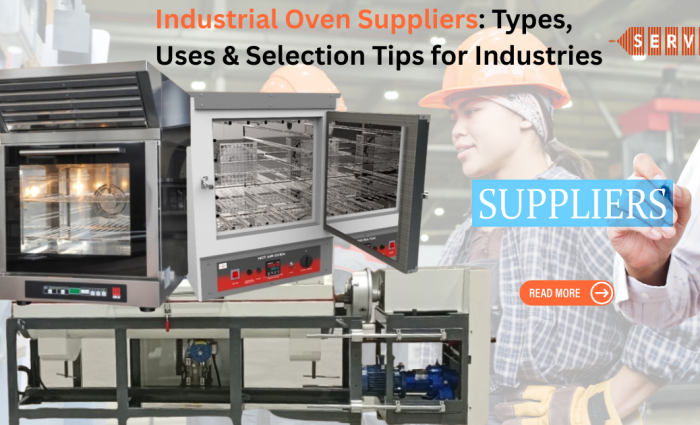
The right industrial oven can boost efficiency and product quality, while the wrong choice can silently increase costs and downtime.
Choosing the right industrial oven suppliers is a critical decision for industries that rely on precise heating, drying, or curing processes. From manufacturing units to pharmaceutical and electronics companies, industrial ovens play a vital role in product quality, consistency, and operational efficiency.
However, selecting the wrong oven or partnering with unreliable industrial oven suppliers can lead to uneven heating, excessive energy consumption, frequent breakdowns, and increased maintenance costs. This guide helps industries understand different types of industrial ovens, their applications, and smart selection tips to make cost-effective, performance-driven decisions.
Understanding Industrial Ovens and Their Role in Industries
Industrial ovens are advanced industrial heating equipment designed to perform controlled thermal processes such as drying, curing, annealing, and heat treatment. Unlike domestic or commercial ovens, they are built for continuous industrial use, higher temperatures, and uniform heat distribution.
Reputed industrial oven suppliers like Servo Enterprises design ovens that meet diverse process requirements while ensuring safety, durability, and energy efficiency. As a leading laboratory equipment manufacturer and industrial testing equipment supplier in Chennai, Servo Enterprises offers customised oven solutions for varied industrial needs.
Industrial ovens are essential industrial heating equipment, enabling precise drying, curing, and heat treatment across manufacturing, pharmaceuticals, electronics, and material-processing industries.
Types of Industrial Ovens and Their Applications
Understanding oven types is essential to avoid wrong selection and operational inefficiencies.
1. Batch Ovens
Batch ovens handle products in set quantities and operating cycles, making these industrial ovens well-suited for low to medium production volumes that demand process flexibility and controlled heating.
Applications:
- Component drying
- Paint curing
- Heat treatment in manufacturing and R&D labs
2. Conveyor Ovens
Conveyor ovens support uninterrupted heating processes and are commonly integrated into automated production lines to ensure consistent output, faster cycle times, and improved efficiency.
Applications:
- Automotive component curing
- Electronics assembly drying
- High-volume manufacturing
These ovens help reduce handling time and improve production efficiency.
3. Curing Ovens
Curing ovens trigger controlled chemical processes that transform coatings, adhesives, and composite materials into hardened, durable finishes, ensuring improved strength, adhesion, thermal resistance, and long-term performance across industrial applications globally.
Applications:
- Powder coating
- Rubber and polymer curing
- Adhesive bonding processes
Uniform temperature control is critical in curing operations to avoid defects.
4. Hot Air Ovens (Drying Ovens)
A hot air oven is widely used as a drying oven for industry, employing forced air circulation to ensure uniform heat distribution and consistent moisture removal across materials during operations.
Applications:
- Food processing
- Electronics drying
- Laboratory sample preparation
Servo Enterprises designs hot air ovens with precise airflow to eliminate uneven heating issues.
5. Vacuum Ovens
A hot air oven is widely used as a drying oven for industry, employing forced air circulation to ensure uniform heat distribution and consistent moisture removal across materials during operations.
Applications:
- Pharmaceuticals
- Electronics and semiconductors
- Advanced material research
These ovens are preferred where low-temperature drying is essential.
6. Infrared Ovens
Infrared ovens operate by emitting radiant heat that directly targets the product surface, enabling faster heating cycles, improved energy efficiency, and precise temperature control compared to conventional convection-based heating methods.
Applications:
- Paint and coating drying
- Plastic forming
- Surface pre-heating
They offer faster cycles and reduced energy consumption compared to conventional systems.
7. Post Curing and Annealing Ovens
Post curing ovens improve strength, stability, and performance of materials after the initial curing process, whereas annealing ovens are designed to alter metal structure, reducing stress and enhancing ductility.
Applications:
- Composite strengthening
- Metal stress relief
- Tooling and mould industries
These specialised industrial ovens improve long-term product performance.
Industry-wise applications of industrial ovens
Reliable industrial oven suppliers serve multiple industries, including:
- Manufacturing units: Heat treatment, drying, curing of components
- Food processing units: Dehydration, sterilisation, baking support processes
- Pharmaceuticals: Vacuum drying, stability testing, controlled heating
- Electronics manufacturers: PCB drying, moisture removal, component ageing
- Automotive and aerospace: Coating, composite curing, metal treatment
As an experienced laboratory equipment manufacturer, Servo Enterprises understands industry-specific compliance and performance demands.
How to Select the Right Industrial Oven Supplier
Post curing ovens improve material strength and stability after primary curing, whereas annealing ovens alter metal structure to enhance ductility, reduce stress, and improve overall mechanical performance.
1. Define Process Requirements Clearly
Identify:
- Temperature range
- Batch or continuous operation
- Product size and material
Incorrect assessment often results in wrong oven selection and rework costs.
2. Ensure Uniform Heating Performance
Uneven heating is a major pain point in industrial heating equipment. Look for:
- Forced air circulation
- Optimised airflow design
- Accurate temperature sensors
Uniform heating improves product quality and reduces rejects.
3. Focus on Energy Efficiency
High energy consumption increases operational costs. Choose ovens with:
- High-grade insulation
- Efficient heating elements
- Optimised airflow systems
Energy-efficient drying ovens for industry solutions deliver long-term savings.
4. Evaluate Supplier Reliability
Trusted industrial oven suppliers provide:
- Customised designs
- Installation and commissioning support
- After-sales service and AMC
Servo Enterprises offers end-to-end support, reducing downtime and maintenance challenges.
5. Safety and Control Features
Modern industrial ovens should include:
- Digital PID controllers
- Over-temperature protection
- Safety alarms and interlocks
Advanced controls ensure repeatability and operator safety.
Comparison of Industrial Oven Types and Temperature Range
Understanding temperature ranges and oven types helps industries select suitable heating solutions for specific applications and consistent processing needs.
| Oven Type | Typical Temperature Range | Key Applications |
| Batch Oven | Ambient to 250°C | Drying, curing, testing |
| Conveyor Oven | 100°C to 300°C+ | Continuous production |
| Hot Air Oven | Ambient to 250°C | Drying, sterilisation |
| Vacuum Oven | Ambient to 250°C | Sensitive material drying |
| Infrared Oven | Ambient to 400°C | Rapid surface heating |
| Post Curing Oven | Ambient to 300°C | Composite strengthening |
Comparing oven types by temperature range ensures informed decisions, improved process efficiency, reduced energy waste, and long-term operational reliability.
Final Words
Selecting the right industrial oven suppliers is essential for consistent quality, lower energy costs, and reliable operations. By understanding oven types, applications, and selection criteria, industries can avoid costly mistakes and improve productivity.
With proven expertise in industrial heating equipment, Servo Enterprises delivers dependable oven solutions made for industrial needs.
Looking for the right industrial oven for your application?
Visit www.servoenterprises.com to explore customised solutions from trusted industrial oven suppliers.
Frequently Asked Questions
- What are industrial ovens mainly used for?
Industrial ovens are used for drying, curing, heat treatment, sterilisation, and material conditioning in industrial processes. - How do I choose the right drying oven for industry?
Evaluate temperature needs, airflow uniformity, energy efficiency, and supplier support before selection. - Are industrial ovens energy-efficient?
Modern ovens designed by experienced industrial oven suppliers use insulation and efficient heating systems to reduce power consumption. - Why choose Servo Enterprises for industrial ovens?
Servo Enterprises combines engineering expertise, custom manufacturing, and strong after-sales support as a trusted laboratory equipment manufacturer. - Can industrial ovens be customised?
Yes, ovens can be customised based on size, temperature range, material, and industry-specific requirements.