
In today’s highly competitive manufacturing landscape, product durability and quality assurance have become critical factors across industries. From automotive components and industrial coatings to electronics and aerospace equipment, manufacturers are expected to deliver products that can withstand harsh environmental conditions for years. As industries continue to prioritize compliance, durability, and export quality standards, the demand for reliable salt spray chamber manufacturers in India is growing rapidly in 2026.
For QA managers, R&D teams, testing laboratories, and production engineers, understanding how corrosion testing works is essential for selecting the right testing equipment and maintaining global quality standards.
Why Corrosion Testing is Essential in Modern Industries
Corrosion is one of the leading causes of product failure in industrial applications. Exposure to moisture, salt, humidity, and chemicals can gradually weaken metals and coated surfaces, resulting in structural damage, reduced performance, and costly replacements.
Industries such as automotive, marine, aerospace, construction, and electronics heavily rely on corrosion testing to ensure product reliability and safety. A high-quality Corrosion test chamber India solution helps manufacturers identify material weaknesses before products reach the market.
Today, many companies also use advanced environmental test chamber systems to meet international export regulations and customer expectations. Without proper corrosion testing, manufacturers risk compliance failures, warranty claims, and loss of customer trust.
What Is a Salt Spray Chamber?
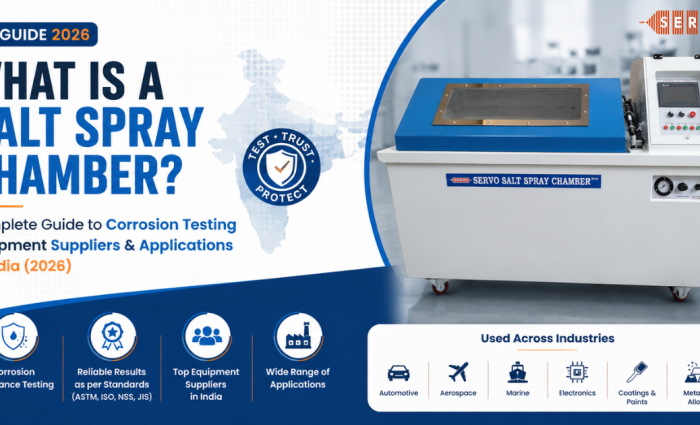
A salt spray chamber is a specialized corrosion testing equipment designed to simulate accelerated corrosive environmental conditions. It exposes test samples to a controlled saline fog environment to evaluate their resistance against rust, corrosion, and coating degradation.
Also referred to as a salt spray fog cabinet, this testing system helps manufacturers analyze the lifespan and durability of metals, electroplated surfaces, painted components, and protective coatings.
The chamber typically consists of:
- Test cabinet
- Salt solution reservoir
- Air saturator
- Atomizing nozzle
- Temperature control system
- Humidity control mechanism
Modern salt spray test machine models are equipped with digital controllers, PLC automation, and programmable testing cycles for precise and repeatable testing performance.
As one of the most important categories of salt spray test equipment, these chambers are widely used in quality assurance laboratories and industrial R&D facilities.
How Does a Salt Spray Chamber Work?
The working principle of a salt spray chamber is based on accelerated corrosion simulation under controlled laboratory conditions.
1. Preparation of Salt Solution
A calibrated sodium chloride solution is prepared following ASTM or ISO testing standards to create a controlled corrosive environment that accurately simulates long-term exposure to salt-laden atmospheric conditions during industrial corrosion testing procedures.
2. Placement of Test Samples
Metallic, coated, or plated test specimens are positioned inside the chamber at predefined angles to ensure uniform exposure to saline fog and achieve consistent, repeatable corrosion testing results across different material samples.
3. Salt Fog Generation
Compressed air is directed through a precision atomizing nozzle, which converts the salt solution into a dense saline mist that circulates evenly throughout the chamber for accelerated corrosion simulation testing.
4. Controlled Environmental Conditions
The chamber continuously regulates temperature, humidity, air pressure, and fog density to maintain stable environmental conditions required for accurate corrosion resistance evaluation and compliance with international testing standards.
5. Corrosion Observation
After the specified testing duration, samples are thoroughly examined for visible signs of corrosion such as rust formation, coating deterioration, blistering, oxidation, or surface degradation to assess long-term material durability and performance.
Many modern salt spray test chamber manufacturers now integrate smart monitoring systems and automated reporting features for advanced industrial testing applications.
Important Standards for Salt Spray Testing
International compliance standards play a critical role in corrosion testing accuracy and acceptance.
ASTM B117 Standard
The salt spray chamber astm b117 standard is one of the most widely recognized corrosion testing standards globally. It defines the operating conditions, salt concentration, chamber temperature, and fog collection parameters for neutral salt spray testing.
Manufacturers exporting industrial products often require salt spray chamber astm b117 compliance to meet global quality expectations.
ISO 9227 Standard
ISO 9227 is an internationally recognized corrosion testing standard that defines procedures for neutral salt spray, acetic acid salt spray, and copper accelerated salt spray testing to evaluate the corrosion resistance of coated and metallic materials.
JIS Standards
Japanese Industrial Standards (JIS) provide corrosion testing guidelines widely adopted in automotive, electronics, and precision manufacturing industries to ensure product durability, coating performance, and compliance with strict international quality requirements.
Reliable salt spray test equipment ensures accurate compliance with these international standards, helping manufacturers maintain product credibility and export readiness.
Applications of Salt Spray Chambers Across Industries
Salt spray testing is essential across multiple industrial sectors where corrosion resistance directly impacts product performance and safety.
Automotive Industry
Automotive manufacturers test chassis parts, fasteners, alloy wheels, and coated components for long-term corrosion resistance.
Paint and Coating Industry
Powder coatings, electroplated surfaces, and industrial paints are evaluated using salt spray test machine systems to verify coating durability.
Electronics and Electrical Components
Connectors, enclosures, and PCB coatings undergo corrosion testing to ensure performance under humid and saline conditions.
Aerospace and Defence
Aircraft components and defence equipment require highly accurate corrosion testing to ensure operational reliability.
Marine and Infrastructure Applications
Marine hardware, construction materials, and infrastructure components are frequently tested using Corrosion test chamber India solutions to withstand harsh environmental exposure.
Key Factors to Consider Before Buying a Salt Spray Chamber
Selecting the right corrosion testing equipment requires careful evaluation of technical specifications and supplier capabilities.
| Factor | Short Description |
| Chamber Capacity | Select chamber size based on sample volume and testing requirements. |
| Material Construction | Prefer FRP or PVC chambers for better corrosion resistance and durability. |
| Compliance Standards | Ensure support for ASTM, ISO, and industry testing standards. |
| Automation Features | Look for PLC controls, touchscreen operation, and automated test cycles. |
| Calibration & Service Support | Choose suppliers offering reliable calibration and technical assistance. |
Many buyers face challenges due to unreliable suppliers, inconsistent test results, and poor after-sales support. This is why choosing experienced salt spray chamber manufacturers in India becomes important for long-term operational efficiency.
Why Servo Enterprises Is a Trusted Salt Spray Chamber Manufacturer in India
Choosing the right supplier is essential for achieving accurate corrosion testing, long-term equipment reliability, and industry compliance. Servo Enterprises stands among the trusted salt spray chamber manufacturers in India, offering advanced corrosion testing solutions tailored for industrial laboratories, QA departments, and R&D facilities.
With strong expertise in industrial testing equipment manufacturing, Servo Enterprises focuses on delivering high-performance systems that meet ASTM, ISO, and industry-specific testing standards. The company provides customized chamber solutions designed to match varying testing capacities and operational requirements.
Key Advantages of Choosing Servo Enterprises
- ASTM & ISO compliant testing equipment
- Custom-built chamber manufacturing capabilities
- Advanced PLC and automated control systems
- Technical consultation and application support
- Installation and operator training assistance
By combining engineering precision, compliance-focused manufacturing, and dependable technical support, Servo Enterprises helps industries improve quality assurance processes, corrosion testing accuracy, and long-term product reliability.
Conclusion
Corrosion testing is vital for ensuring product durability, compliance, and quality assurance across industries. As trusted salt spray chamber manufacturers in India, Servo Enterprises delivers reliable corrosion testing solutions that enhance operational efficiency, testing accuracy, and long-term industrial performance.
Looking for reliable corrosion testing solutions for your industry? Partner with Servo Enterprises for high-performance salt spray chambers designed to meet ASTM and ISO standards.
Frequently Asked Questions (FAQs)
1) What is a salt spray chamber used for?
A salt spray chamber is used to test the corrosion resistance of metals, coatings, and industrial components under accelerated saline conditions.
2) What is ASTM B117 salt spray testing?
ASTM B117 is an international standard that defines operating conditions for neutral salt spray corrosion testing.
3) Which industries use salt spray test equipment?
Automotive, aerospace, electronics, marine, construction, and coating industries widely use corrosion testing equipment.
4) What is the difference between NSS and CASS testing?
NSS uses neutral salt fog, while CASS is a more aggressive corrosion testing method used for decorative and automotive coatings.
5) How do I choose the right salt spray chamber manufacturer in India?
Evaluate suppliers based on compliance standards, customization options, service support, calibration assistance, and industry experience.