
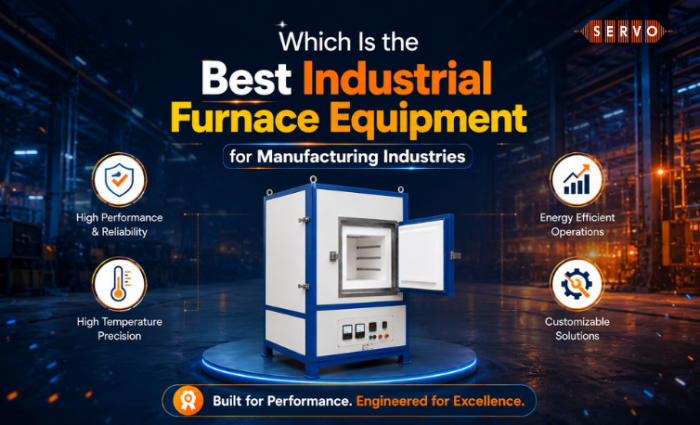
Manufacturing industries rely heavily on thermal processing systems to achieve product quality, consistency, and operational efficiency. From metal treatment and material testing to ceramics processing and advanced industrial production, the right furnace plays a critical role in determining manufacturing outcomes. For industrial buyers evaluating options from leading industrial furnace manufacturers, understanding furnace types, performance capabilities, energy efficiency, and operational requirements is essential.
This guide explores the different types of furnace systems, their applications, and the key factors that help determine the best solution for modern manufacturing operations.
The Role of Industrial Furnace Equipment in Modern Manufacturing
Industrial furnaces are designed to generate and maintain controlled temperatures required for manufacturing and thermal processing applications. These systems are used for heating, annealing, tempering, sintering, stress relieving, drying, and various heat treatment processes that improve material properties and product performance.
In modern manufacturing facilities, Industrial Furnace Equipment contributes to higher production quality, improved process consistency, and improved operational efficiency. Without reliable thermal processing systems, industries may face challenges related to product defects, inconsistent material properties, and increased production costs.
Industries That Depend on High-Temperature Processing
Several industries rely on furnace systems to meet demanding production requirements, including:
- Metal and steel manufacturing
- Automotive component production
- Aerospace engineering
- Ceramics and glass processing
- Electronics manufacturing
- Research and testing laboratories
- Heavy engineering industries
The growing demand for precision manufacturing has increased the need for advanced solutions supplied by experienced industrial furnace manufacturers.
What Is Industrial Furnace Equipment?
Industrial furnaces are specialized thermal processing systems that generate controlled heat for various industrial applications. Depending on the process requirement, furnaces can operate at moderate temperatures or extreme thermal ranges exceeding 1700°C.
These systems are designed to deliver uniform heat distribution, accurate temperature control, and efficient energy utilization while maintaining operational safety.
Common Applications of Industrial Furnace Equipment
The applications of Industrial Furnace Equipment extend across numerous sectors and processes, including:
- Heat treatment
- Annealing
- Sintering
- Material testing
- Stress relieving
- Drying and curing
- Metallurgical processing
- Ceramic firing
The ability to customize furnace specifications based on industrial requirements makes these systems indispensable for manufacturing operations.
Different Types of Industrial Furnace Equipment and Their Applications
High Temperature Furnace Equipment for Precision Manufacturing
Among the most versatile solutions available today, high temperature furnace equipment is designed for industries that require extreme thermal processing conditions. These furnaces can achieve temperatures up to 1800°C and are widely used in metallurgy, ceramics, aerospace, electronics, and advanced materials manufacturing.
Key advantages include:
- High operating temperatures
- Uniform heat distribution
- Advanced PID temperature control
- Energy-efficient insulation systems
- Enhanced process accuracy
For manufacturers seeking precision and flexibility, high temperature furnace equipment is often considered the preferred choice for demanding industrial applications.
Bogie Hearth Furnace for Heavy-Duty Industrial Applications
Bogie Hearth Furnaces are engineered for processing large and heavy workpieces. These furnaces feature movable hearth systems that simplify loading and unloading while supporting large-scale production requirements.
Typical applications include:
- Steel fabrication
- Forging industries
- Railway component manufacturing
- Aerospace structures
- Heavy engineering equipment
As a highly effective heat treatment furnace, this equipment is ideal for industries handling oversized components that require consistent thermal processing.
Muffle Furnace for Testing, Research, and Quality Control
Muffle Furnaces are widely used in laboratories, testing centers, and research facilities where precise and contamination-free heating is essential.
Common applications include:
- Material testing
- Ash content determination
- Metallurgical analysis
- Quality assurance
- Research and development
These furnaces provide exceptional temperature accuracy and repeatability, making them valuable tools for industrial laboratories.
Which Is the Best Industrial Furnace Equipment for Manufacturing Industries?
Best Furnace for High-Temperature Manufacturing Operations
For most manufacturing sectors, an industrial high temperature furnace offers the best combination of versatility, efficiency, and performance. These systems support a wide range of thermal processes while delivering precise temperature control and superior product quality.
Industries that process advanced materials, ceramics, aerospace components, and metallurgical products often benefit significantly from investing in a reliable industrial high temperature furnace.
Best Heat Treatment Furnace for Heavy Engineering Industries
Heavy manufacturing facilities often require furnace systems capable of handling large workpieces and high production volumes. In such environments, a Bogie Hearth Furnace serves as an effective heat treatment furnace, providing excellent temperature uniformity and operational efficiency.
Its ability to process bulky components makes it particularly valuable for engineering, automotive, and infrastructure projects.
Best Furnace Solution for Laboratories and R&D Facilities
Research institutions and quality control laboratories typically prioritize accuracy over production volume. Muffle Furnaces offer precise temperature management and contamination-free environments, making them ideal for testing and analytical applications.
Ultimately, the best furnace depends on the operational objectives, production requirements, and process demands of the facility.
Factors to Consider on Choosing Industrial Furnace Equipment
Temperature Range and Process Requirements
Every manufacturing process has unique thermal requirements. Buyers should evaluate the maximum operating temperature needed for their applications before selecting a furnace.
For advanced material processing, high temperature furnace equipment capable of operating above 1500°C may be required.
Energy Efficiency and Operating Costs
Energy consumption significantly impacts operating expenses. Modern furnace systems utilize advanced insulation materials and optimized heating elements to reduce heat loss and improve efficiency.
Selecting energy-efficient Industrial Furnace Equipment can help manufacturers lower operational costs while maintaining production performance.
Temperature Control Accuracy and Uniformity
Precise temperature control is essential for achieving consistent product quality. Advanced PID controllers and intelligent monitoring systems help maintain accurate thermal conditions throughout the process cycle.
Equipment Durability and Service Life
Industrial environments demand robust equipment capable of withstanding continuous operation. High-quality construction materials, reliable heating elements, and durable insulation contribute to longer service life and reduced maintenance requirements.
Automation and Smart Control Features
Many modern furnaces now incorporate automation technologies that improve productivity and process consistency. Features such as programmable controls, data logging, and remote monitoring enhance operational efficiency and reduce manual intervention.
The Importance of Energy-Efficient Furnace Operations
i) Reducing Energy Consumption Through Advanced Insulation
Energy efficiency remains a key consideration for manufacturers seeking sustainable operations. Advanced ceramic insulation systems reduce heat loss and enable faster heating cycles, improving overall furnace performance.
A well-designed industrial high temperature furnace can significantly reduce energy consumption compared to outdated thermal processing systems.
ii) Improving Productivity with Optimized Heat Distribution
Uniform heat distribution ensures that products receive consistent thermal treatment throughout the process. This reduces rejection rates, improves product quality, and increases manufacturing productivity.
How to Select Reliable Industrial Furnace Manufacturers
Evaluating Manufacturing Experience
When selecting among various industrial furnace manufacturers, buyers should assess the company’s engineering expertise, product portfolio, and industry experience.
Manufacturers with proven experience are better positioned to deliver customized solutions that meet specific operational requirements.
Importance of Product Quality
Not all industrial furnace suppliers offer the same level of customization. Industries with specialized applications often require tailored furnace configurations to achieve optimal performance.
Working with experienced industrial furnace suppliers ensures access to application-specific solutions designed for long-term operational success.
Assessing After-Sales Support and Service Availability
Reliable after-sales support is critical for minimizing downtime and maintaining productivity. Buyers should evaluate service responsiveness, spare parts availability, and technical assistance capabilities before making a purchase decision.
Latest Furnace Equipment India Trends Shaping Manufacturing in 2026
i) Industry 4.0 and Smart Furnace Integration
The adoption of Industry 4.0 technologies is transforming the landscape of furnace equipment India. Smart furnace systems now provide real-time performance monitoring and automated process optimization.
ii) Advanced PID Temperature Control Systems
Modern furnace designs incorporate intelligent PID controllers that improve process accuracy and reduce temperature fluctuations.
iii) Remote Monitoring
Manufacturers are increasingly adopting remote monitoring technologies to improve operational visibility and support predictive maintenance initiatives.
iv) Energy-Efficient Furnace Technologies
Sustainability continues to influence innovation within the furnace equipment India market. Energy-efficient designs, improved insulation systems, and optimized heating technologies are helping industries reduce their environmental impact while improving productivity.
Why Servo Enterprises Is a Trusted Choice
Servo Enterprises offers a range of furnace systems designed to support manufacturing, testing, research, and thermal processing applications across multiple industries.
Focus on Performance, Efficiency, and Reliability
By combining advanced engineering, precision temperature control, and robust construction, we deliver solutions that meet demanding industrial requirements.
Supporting Manufacturing Excellence Across India
As one of the established industrial furnace manufacturers, Servo Enterprises focuses on providing dependable thermal processing solutions that help industries improve operational performance, efficiency, and product quality. We also serves businesses seeking trusted industrial furnace suppliers and advanced furnace equipment India solutions.
Final Words
At Servo Enterprises, we are committed to delivering reliable, performance-driven furnace solutions that meet the evolving needs of diverse industries. As one of the trusted industrial furnace manufacturers, we focus on engineering excellence, durability, and energy-efficient design, helping customers achieve consistent results and long-term operational value. Our reputation as dependable industrial furnace suppliers is built on quality, customization, and customer-first support across every stage of the manufacturing process.
Partner with Servo Enterprises to upgrade your thermal processing capabilities with precision-built furnace solutions.
FAQs on Industrial Furnace Equipment
1. What is industrial furnace equipment used for?
Industrial furnace equipment is used for heat treatment processes such as annealing, sintering, tempering, and material testing across manufacturing industries.
2. Which is the best furnace for manufacturing industries?
The industrial high temperature furnace is often the most versatile choice due to its wide temperature range, efficiency, and process flexibility.
3. What industries use heat treatment furnaces?
Heat treatment furnaces are widely used in automotive, aerospace, steel, heavy engineering, ceramics, and electronics manufacturing industries.
4. How do I choose the right industrial furnace?
Selection depends on temperature range, production volume, energy efficiency, automation level, and specific application requirements.
5. Why choose Servo Enterprises for furnace equipment?
Servo Enterprises is known for reliable, durable, and energy-efficient furnace solutions backed by strong engineering expertise and customer-focused support.