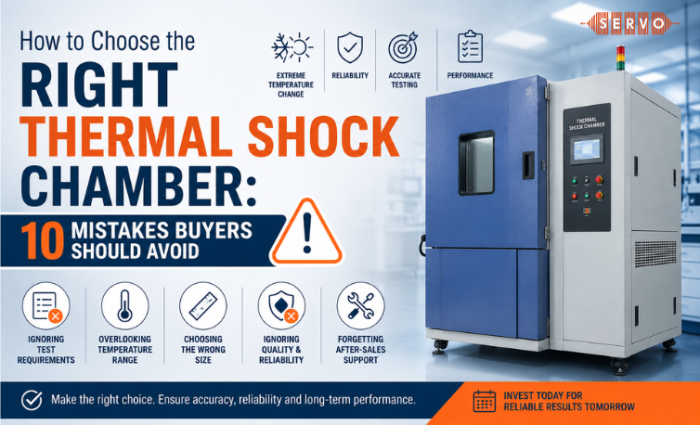
Looking for a reliable Thermal Shock Chamber Manufacturer in India? Choosing the right thermal shock chamber is an important decision for laboratories, QA teams, R&D departments and manufacturers testing electronics, automotive components, aerospace assemblies, defence equipment, PCBs, telecom devices, plastics, rubber and composite materials. A suitable thermal shock test chamber should match your required temperature range, transfer time, specimen size, test standard, cycle requirements and workload—not simply the lowest purchase price.
Thermal shock testing helps evaluate how products and materials withstand sudden temperature changes that can occur during transportation, startup, shutdown, altitude changes or outdoor exposure. These rapid temperature transitions can create thermal expansion and contraction stresses that may contribute to cracking, delamination, solder-joint failure, seal damage or material fatigue.
Before you compare thermal shock chamber prices or request quotations, here are 10 common mistakes buyers should avoid when selecting thermal shock testing equipment.
1. Choosing a Chamber Based Only on Temperature Range
One of the most common purchasing mistakes is selecting a chamber simply because its advertised temperature range appears suitable. Temperature limits are important, but they do not define thermal shock performance by themselves.
A proper Thermal Shock Test Chamber must also provide rapid transition between hot and cold zones, adequate temperature recovery, suitable uniformity and repeatable cycle control.
Practical solution: Before requesting quotations, define the complete test profile, including high and low temperatures, dwell time, transfer time, recovery requirement and number of cycles.
2. Ignoring Specimen Size and Test Capacity
Another mistake is selecting chamber capacity without considering the actual dimensions, quantity and thermal mass of test specimens. A chamber may have an adequate nominal volume but still be unsuitable if fixtures, mounting arrangements or large components restrict usable working space.
For a Laboratory Thermal Shock Chamber, buyers should calculate the usable test volume rather than simply considering the external dimensions. The thermal mass of the load should also be considered because a heavily loaded chamber may require different recovery characteristics than an unloaded system.
Practical solution: Provide the supplier with specimen dimensions, weight, quantity, fixture requirements and expected future load expansion before finalizing capacity.
3. Ignoring Transfer Time and Temperature Recovery
Thermal shock testing is fundamentally different from slowly changing the temperature in a conventional environmental chamber. The specimen must experience a sufficiently rapid transition between temperature extremes.
- IEC 60068-2-14:2023 identifies the rate of temperature change as one of the parameters affecting temperature-change testing.
- MIL-STD-883 Method 1011.10 also defines transfer time and specifies a total transfer time of no more than 10 seconds for the applicable test procedure.
Practical solution: Ask for documented transfer and recovery performance under representative load conditions instead of accepting only no-load specifications.
4. Selecting Capacity Only for Current Requirements
Buying the smallest possible chamber can reduce the initial investment, but it may become a limitation when product sizes, sample quantities or testing programmes increase.
An Industrial Thermal Shock Chamber should therefore be selected with a reasonable allowance for future requirements. Automotive suppliers, electronics manufacturers and aerospace laboratories may initially test individual components but later require testing of larger assemblies or increased sample volumes.
Oversizing, however, can also increase capital and operating costs unnecessarily.
Practical solution: Assess current workload, expected product development, future sample volumes and planned validation programmes before choosing chamber capacity.
5. Failing to Check Temperature Uniformity
Temperature range and transfer speed receive considerable attention, while temperature uniformity is sometimes overlooked. However, non-uniform temperature distribution can expose specimens at different positions to different thermal conditions, potentially affecting test repeatability.
For reliable testing, buyers should distinguish between temperature accuracy, temperature uniformity, stability and recovery. These are related but different performance characteristics.
Practical solution: Request temperature mapping, calibration information and uniformity specifications applicable to the actual working zone and intended load.
6. Buying Without Checking the Applicable Testing Standard
A chamber should be selected according to the required test method rather than purchased first and matched to a standard later.
IEC 60068-2-14:2023, Test N, covers change-of-temperature testing and was technically revised from the previous 2009 edition. It addresses rapid temperature changes and related test parameters.
For microelectronic devices, MIL-STD-883 includes Method 1011 for thermal shock, with defined requirements concerning temperature conditions, transfer time, dwell and load.
Practical solution: Give the supplier the applicable standard, test method, temperature limits, cycle count and acceptance criteria before receiving a final quotation.
7. Ignoring Controls, Data Logging and Test Traceability
A thermal shock chamber is not simply a heating and cooling cabinet. Modern QA and R&D laboratories often require programmable test sequences and traceable test data.
This is particularly important when laboratories need to demonstrate that a specimen completed a prescribed test sequence.
Practical solution: Evaluate controller functionality, cycle programming, alarm management, data recording, export options and remote monitoring before purchase.
8. Underestimating Cooling, Heating and Utility Requirements
Buyers sometimes focus on the chamber’s performance specifications without evaluating the infrastructure required to operate it.
Cooling configuration can influence installation requirements, ventilation and maintenance. Electrical capacity, floor space and access for servicing should also be considered.
Practical solution: Confirm electrical supply, cooling arrangement, installation area, ventilation, access clearance and other utility requirements before placing the purchase order.
9. Choosing the Lowest Purchase Price Instead of Total Cost of Ownership
A low initial quotation does not necessarily represent the most economical solution. Thermal shock chambers contain refrigeration, heating, controls, sensors and mechanical transfer systems that require periodic servicing and calibration.
Energy consumption, preventive maintenance, spare parts, calibration, service response and downtime can significantly affect lifecycle costs.
Practical solution: Compare suppliers using total cost of ownership rather than purchase price alone. Ask about preventive maintenance schedules, calibration intervals, consumables, spare parts and expected service response times.
10. Not Evaluating the Manufacturer’s After-Sales Support
Even a technically capable chamber can become a costly asset if technical support is inadequate. Refrigeration faults, sensor issues, controller problems and calibration requirements can interrupt critical validation programmes.
A reliable Thermal Shock Chamber Supplier should be able to support installation, commissioning, calibration, troubleshooting, preventive maintenance and spare-parts requirements.
Practical solution: Evaluate the supplier’s engineering capability, installation support, calibration services, AMC options, spare-parts availability and response capability before purchase.
Thermal Shock Chamber Buyer Checklist
Before selecting a Thermal Shock Testing Equipment system, laboratory and QA teams should verify:
- Temperature & Performance: Hot/cold range, transfer time, recovery, uniformity and stability.
- Capacity & Testing: Specimen size, thermal load, basket volume, cycle count and dwell/soak time.
- Standards & Controls: Applicable standards, PLC/HMI programming, data logging and USB export.
- Utilities & Maintenance: Cooling type, electrical needs, installation, calibration and AMC.
- Supplier Support: Spare parts, commissioning, technical assistance and after-sales service.
This checklist helps buyers compare quotations on technical suitability rather than price alone.
Why Servo Enterprises Is a Practical Choice for Thermal Shock Testing
According to Servo Enterprises, choosing a Thermal Shock Chamber Manufacturer in India should begin with the actual testing application rather than a standard, one-size-fits-all configuration.
Our team evaluates the testing standard, specimen characteristics, temperature profile, cycle requirements and expected workload to determine the appropriate chamber specifications.
- Application-focused configuration: Servo Enterprises considers the specific testing requirements before recommending a suitable chamber configuration.
- Two-zone and three-zone options: Its thermal shock chambers are available in configurations suited to different testing methods and application requirements.
- Customizable test capacity: Test basket volumes can be customized from 30 L to 200 L, helping accommodate different specimen sizes and testing loads.
- PLC/HMI-based operation: Programmable controls support automated temperature cycles, monitoring and test management.
- Data and remote monitoring options: Optional data logging, USB export and remote monitoring support better test traceability and operational oversight.
Servo Enterprises states that its thermal shock chambers cater to testing applications across various materials. For laboratories evaluating a dependable Thermal Shock Chamber Supplier, discussing the application and technical requirements with the manufacturer before purchase can help prevent capacity limitations, unsuitable performance specifications and avoidable lifecycle costs.
Choose the Right Thermal Shock Chamber
Selecting the right chamber is ultimately a reliability and compliance decision, not simply an equipment purchase. If you are evaluating a Thermal Shock Chamber Manufacturer in India, discuss your specimen dimensions, temperature requirements, cycle profile and applicable standards with Servo Enterprises.
Our engineering team can help identify a suitable chamber configuration for laboratory, automotive, aerospace, electronics and industrial testing applications.
Choose Thermal Shock Testing with Confidence. Contact Servo Enterprises for expert guidance and a suitable chamber.
Frequently Asked Questions(FAQs)
1) What is a thermal shock chamber used for?
A thermal shock chamber exposes specimens to rapid transitions between hot and cold environments. It helps evaluate resistance to thermal expansion and contraction stresses in components and materials used in automotive, aerospace, electronics, defence and other demanding applications.
2) What temperature range should I consider?
The required range depends on the applicable test standard and product specification. Servo’s chamber provides a hot range of +60°C to +200°C and a cold range of -10°C to -70°C.
3) Why is transfer time important in thermal shock testing?
Transfer time determines how rapidly the specimen moves between thermal environments. A long transition may reduce the severity of the intended thermal shock. Therefore, transfer performance should be evaluated alongside temperature range, dwell time and recovery.
4) Which standards are relevant to thermal shock testing?
IEC 60068-2-14:2023 is a key international standard for change-of-temperature testing. Depending on the product and industry, requirements may also come from MIL-STD, JIS, ASTM, JEDEC or customer-specific specifications.
5) How do I select the right Thermal Shock Testing Equipment?
Start with the required test standard and profile. Then evaluate temperature range, transfer time, recovery, specimen size, thermal load, uniformity, capacity, control system, data logging, utilities, calibration and after-sales support.