
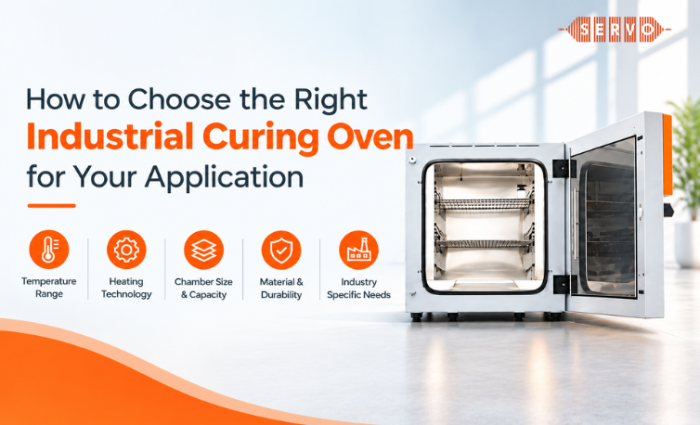
How to Choose the Right Industrial Curing Oven for Your Application
Industrial curing ovens are essential for manufacturing processes where heat must be applied in a controlled and repeatable manner to achieve the required physical, chemical, mechanical or surface properties of a product. The right selection should consider the material, curing profile, product dimensions, production volume, airflow, temperature uniformity, heating method, automation and safety requirements.
For manufacturers evaluating an industrial curing oven manufacturer in India, the objective should therefore be to select a complete thermal-processing solution rather than simply purchase a heating chamber.
What Is an Industrial Curing Oven?
An industrial curing oven is a controlled heating system designed to initiate or accelerate a physical or chemical transformation in a material.
Unlike a conventional drying oven, where the primary objective is often moisture removal, curing may involve cross-linking, polymerisation, bonding or hardening. Curing ovens are commonly used for:
- Powder coating and paint curing
- Rubber vulcanisation
- Polymerisation
- Composite bonding
- Adhesive curing
- Industrial component finishing
- Post-curing of selected materials
Our published model uses forced convection with blowers and offers Digital PID as well as PLC-based control configurations. This makes understanding the first step when evaluating an industrial curing oven supplier.
Different Types of Industrial Curing Ovens and Their Applications
The oven configuration should correspond to the production process rather than being selected solely by price.
-
Batch Curing Ovens
Batch ovens are suitable when products are loaded, processed and unloaded as individual batches. They offer flexibility when manufacturers handle different product sizes, formulations or curing cycles.
They are particularly useful for low-to-medium production volumes, prototype production, job-shop manufacturing and applications where multiple temperature profiles may be required.
-
Conveyor or Continuous Curing Ovens
Continuous ovens transport products through a heated chamber using a conveyor system. They are suitable for high-volume manufacturing where consistent throughput is more important than batch flexibility.
Automotive components, fabricated metal parts, coated products and repetitive production lines may benefit from this configuration.
-
Powder Coating Curing Ovens
A powder coating curing oven is specifically designed to provide the controlled thermal profile required to cure powder-coated surfaces. Temperature uniformity is particularly important because under-curing can reduce coating performance, while excessive heating can affect the finish or substrate.
The correct chamber dimensions, airflow pattern, loading arrangement and dwell time should therefore be established from the coating manufacturer’s curing specification.
-
Infrared and Specialised Ovens
Infrared systems transfer radiant energy directly to suitable product surfaces and can be advantageous where rapid surface heating is required. Other specialised configurations include post-curing ovens, trolley ovens, canopy ovens and vacuum ovens.
Servo’s oven portfolio includes batch, conveyor, curing, canopy, vacuum, infrared, post-curing and trolley-type configurations, allowing the oven architecture to be matched to the thermal process.
8 Factors to Consider When Choosing an Industrial Curing Oven
1. Start With the Material and Curing Process
The material being processed determines the thermal requirements.
Before approaching an industrial curing oven manufacturer in India, document the material composition, coating or adhesive chemistry, recommended curing temperature, required dwell time and acceptable temperature tolerance.
Do not select an oven simply because its maximum temperature exceeds the process temperature. The oven must be capable of delivering the required temperature consistently throughout the actual product load.
2. Determine the Required Temperature Range
Temperature is one of the most important technical parameters. Servo Enterprises’ curing oven is specified for operation from ambient to 250°C, with the temperature range customisable according to the application.
It uses a Digital PID controller for temperature regulation. When specifying an oven, consider:
- Minimum process temperature
- Maximum process temperature
- Heat-up time
- Soak or dwell period
- Ramp-up requirements
- Temperature tolerance
- Product temperature versus chamber temperature
A higher maximum temperature is not automatically better. Selecting a system with an unnecessarily high range can increase cost without improving the process.
3. Select the Correct Chamber Size and Capacity
Chamber dimensions should be calculated from the actual product and loading arrangement. Consider:
- Maximum component dimensions
- Number of components per batch
- Product weight
- Rack or tray dimensions
- Required spacing between components
- Door opening dimensions
- Trolley requirements
- Future production expansion
An undersized oven creates production bottlenecks because operators must process more batches. Conversely, an oversized chamber can consume more energy because a larger volume of air and chamber structure must be heated.
A reliable curing oven manufacturer in India should therefore determine usable working volume rather than simply quoting the external dimensions of the oven.
4. Evaluate Heating Method
The heating system influences heat-up time, operating cost, controllability and suitability for the application.
Servo’s curing oven can be configured with electric, gas or infrared heating, while the published power-source options include electric, diesel and gas.
Electric heating is often preferred where clean operation, precise control and straightforward installation are important.
Gas or diesel systems may be considered for applications where fuel economics or available infrastructure makes them practical. Infrared heating can be advantageous for suitable surface-heating applications.
5. Check Airflow and Temperature Uniformity
Temperature uniformity is one of the most important factors in curing performance.
Even if the controller displays the correct setpoint, the product may experience different temperatures at different locations if airflow is poorly designed. This can create under-cured areas, over-cured surfaces and inconsistent product quality.
Servo’s curing oven uses forced convection with blowers to circulate heated air through the chamber.
When evaluating an industrial heating oven, ask the manufacturer about:
- Blower capacity
- Air circulation pattern
- Heater placement
- Air return arrangement
- Sensor location
- Temperature uniformity
- Load configuration
- Air velocity around the product
The final airflow design should be based on the product geometry and loading pattern, not just the chamber volume.
6. Consider Energy Efficiency
Energy consumption becomes significant when an oven operates for multiple shifts every day. Important efficiency factors include:
- Chamber insulation thickness
- Door sealing
- Heating-element efficiency
- Airflow optimisation
- Heat-loss control
- Cycle time
- Loading efficiency
- Automatic temperature management
Servo specifies glass-wool insulation up to 100 mm and a double-walled, gasket-sealed door in its curing oven design. These construction features help reduce unnecessary heat loss during operation.
When comparing an industrial curing oven supplier, therefore, do not compare equipment only by purchase price. Evaluate the expected operating cost over the equipment’s service life.
7. Match Automation With Production Requirements
Automation can improve repeatability and reduce operator dependency. Servo’s curing oven supports PLC-based/digital controls, semi-automatic and fully automatic operation, with features such as multi-stage temperature profiling, process timers and optional SCADA connectivity.
- PLC control
- Programmable recipes
- Multi-stage temperature profiles
- Automatic cycle control
- Data logging
- SCADA connectivity
- Alarm systems
- Automatic shutdown
The right automation level should reflect the process complexity and production volume.
8. Review Safety and Maintenance Requirements
Industrial heating equipment must incorporate appropriate protection against abnormal operating conditions. Important features include:
- Over-temperature protection
- Safety interlocks
- Automatic shutdown
- Proper insulation
- High-temperature-rated seals
- Electrical protection
- Emergency controls
- Accessible service components
Servo lists integrated safety interlocks, over-temperature protection and auto-shutdown among its curing-oven safety features.
Maintenance should also be considered before purchase. Ask about heater replacement, blower servicing, sensor calibration, electrical components, insulation inspection and availability of spare parts.
How Production Volume Affects Oven Selection
Production volume should directly influence the oven configuration.
| Production requirement | Recommended approach |
| Low-volume or variable production | Batch curing oven |
| Medium-volume production | Larger batch or trolley configuration |
| Large components | Trolley-type or customised chamber |
| High-volume repetitive production | Conveyor/continuous oven |
| Rapid surface heating | Infrared configuration |
| Post-process material strengthening | Post-curing oven |
A batch oven may provide greater flexibility, while a continuous oven can reduce handling time and improve throughput. Servo also offers trolley-type and double-trolley oven configurations for applications involving larger or heavier loads.
Common Industrial Curing Oven Selection Mistakes
Manufacturers can avoid costly problems by identifying selection errors before placing an order.
- i) Choosing only by maximum temperature: A high temperature rating does not guarantee uniform or effective curing.
- ii) Ignoring product loading: The chamber must accommodate the actual product, fixtures and required airflow clearance.
iii) Underestimating production volume: Insufficient capacity increases batch frequency, labour requirements and production delays.
- iv) Ignoring temperature uniformity: A controller setpoint alone cannot guarantee consistent product temperature.
- v) Oversizing the oven: Excess chamber volume can increase heat-up time and energy consumption.
- vi) Selecting inadequate automation: Manual operation may create inconsistencies when several recipes or stages are involved.
vii) Focusing only on purchase price: Energy consumption, maintenance, downtime and service availability contribute significantly to total ownership cost.
Industrial Curing Oven Buyer Checklist
Before requesting a quotation from a curing oven supplier in India, prepare the following information:
- Material & Process: Product type, coating/adhesive, curing temperature and dwell time.
- Capacity & Production: Product dimensions, batch weight, quantity per batch and shift capacity.
- Heating & Airflow: Preferred heating source, available power/fuel and required temperature uniformity.
- Controls & Safety: Automation level, data logging/SCADA, safety features and process controls.
- Installation & Support: Loading method, installation conditions, maintenance and after-sales service requirements.
Providing these details allows the manufacturer to recommend an appropriately engineered system instead of offering a generic oven.
Why Choose Servo Enterprises for an Industrial Curing Oven?
Selecting an industrial oven manufacturer in India should involve more than comparing catalogue specifications. The manufacturer should understand the relationship between material characteristics, thermal profile, chamber design, airflow, controls and production requirements.
Servo Enterprises manufactures curing ovens with application-focused configurations, including forced-air convection, Digital PID control, PLC-based controls, multiple heating options, automated operation and safety systems. Our curing ovens are specified for applications such as powder coating, paint curing and rubber vulcanisation, with custom engineering support available for specific process requirements.
As an industrial curing oven manufacturer in India, we support manufacturers looking for application-specific thermal processing equipment rather than a one-size-fits-all solution.
For organisations evaluating an industrial curing oven manufacturer in India, this application-oriented approach can help reduce the risk of capacity mismatch, poor temperature distribution and unnecessary energy consumption.
Final Words
Choosing the right curing oven is ultimately a process-engineering decision. Material characteristics, curing temperature, dwell time, chamber capacity, production volume, heating method, airflow, temperature uniformity, energy efficiency, automation and safety must all work together to deliver consistent results.
A technically capable curing oven manufacturer in India should therefore evaluate your application before finalising the chamber size, heating system and control architecture.
Servo Enterprises provides application-focused curing ovens for industrial thermal-processing requirements, with configurable heating methods, forced convection, Digital PID/PLC controls, insulation, safety systems and automation options.
Planning to install an industrial curing oven? Share your requirement with Servo Enterprises to discuss the right configuration and request a technical quotation.
Frequently Asked Questions
1) What temperature range is required for an industrial curing oven?
The required temperature depends on the coating, polymer, rubber, adhesive or other material being cured.
2) How do I calculate curing oven capacity?
Capacity should be calculated from product dimensions, number of components per batch, product weight, loading arrangement, required clearance and production volume.
3) Is a powder coating curing oven different from a general industrial oven?
Yes. The oven should therefore be designed around the powder specification, product geometry and production method.
4) Should I choose a batch or continuous curing oven?
A batch oven is generally suitable for flexible or low-to-medium volume production, while a conveyor or continuous system is more appropriate for high-volume repetitive manufacturing.
5) Why is temperature uniformity important in curing?
Temperature uniformity ensures that products throughout the chamber receive the required thermal exposure.